The Long Way Home
Returning to Aotearoa after three decades, Ruebena Paraha, in her 70s, traded a career in interior design for a paintbrush. Crafting intricate, celestial narratives that bridge her global travels with the deep spiritual traditions of her ancestors; she is proof it is never too late to follow your joy.
Words Lucinda Diack
-
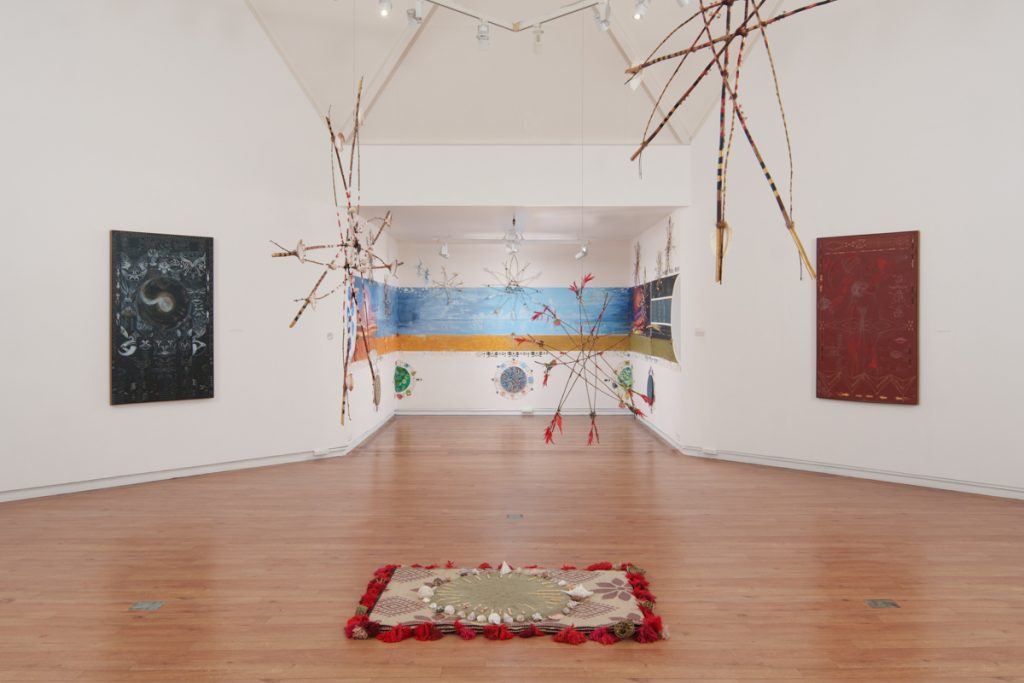
- The installation view of the exhibition illustrates the scale and diversity of her work. For the collection, Ruebena drew on Kahungunu cosmological narratives recorded by Moihi Te Mātorohanga and Nēpia Pōhūhū in the mid nineteenth century, alongside material cultures of voyaging across the Indian Ocean and Te Moana-nui-a-Kiwa. The exhibition design is informed by the star compass developed by Sir Hekenukumai Busby, a leader in the revitalisation of traditional navigation techniques. Photo Thomas Teutenberg
In the soft morning light of Heretaunga Hastings, Ruebena Paraha (Ngāti Hine, Ngāti Tūwharetoa, Ngāti Kahungunu) speaks with the grounded clarity that comes from a life lived in full. She is a woman who has traversed the globe yet now finds her deepest resonance in the soil of her ancestors. At an age when many are slowing down, she is just getting started.
Ruebena’s story is long and winding, or as she describes, one of ‘wayfinding’. A term she uses to describe both the traditional Pacific navigation systems and her personal return to Aotearoa. Leaving New Zealand in the mid-1970s, she admits she left without her Māoritaonga. ‘I left here as a young, radical woman who wanted to see and experience the world,’ she enthuses.
‘I came home in 2007 and realised I knew nothing about my heritage or my matauranga mauri.’ While it would be just over another decade before her career as an interior designer left her wanting more, in her mid-60s, Ruebena embarked on a degree at Toimairangi School of Māori Visual Art; graduating with a Maunga Kura Toi, a Bachelor of Māori Art Ruangi, in 2025. Her first solo exhibition came quickly in March 2026.
Held at Te Whare Toi o Heretaunga Hastings Art Gallery, Wayfinding, is remarkably intricate, drawing on the Kahungunu cosmological narratives recorded in the 19th century. A testament to the traditional pacific navigation systems she spent over a year researching.
Guided by ‘a higher energy’, she describes her art practice as allowing it to ‘come to her’. ‘I have ideas,’ she explains, ‘and I find the words, but I need to dream it, to think about it and feel it. And when all of those align or happen to me, I execute.’
-
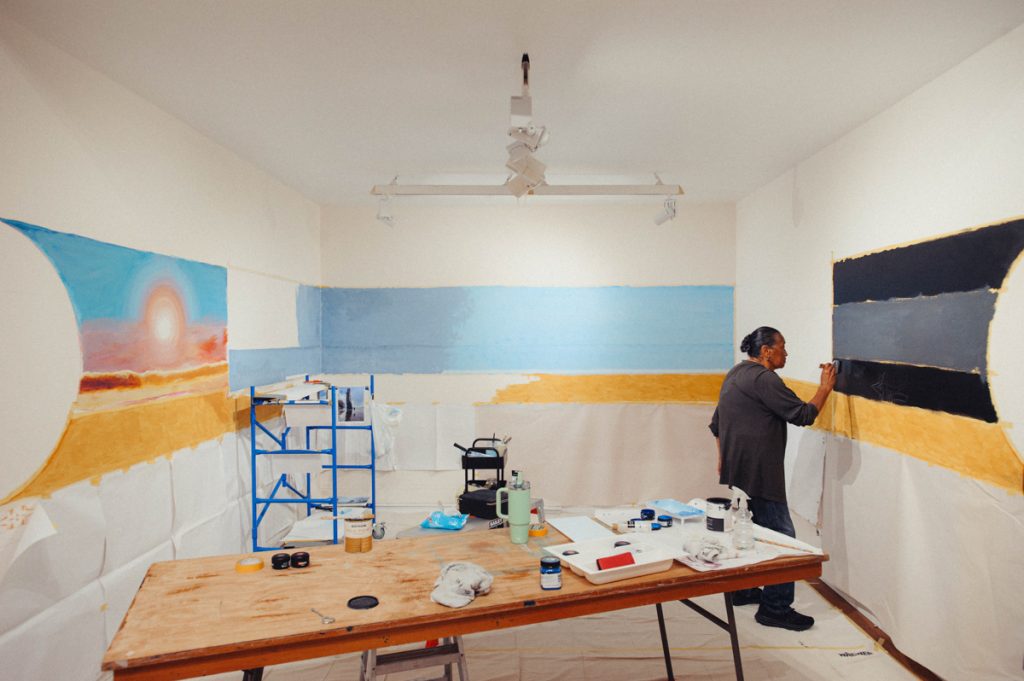
- Wayfinding was Ruebena’s first solo exhibition in a public gallery, Te Whare Toi o Heretaunga Hastings Art Gallery. Here she extended her technique and art practices into a large-scale wall drawing in the exhibition space. Photo Max Bull-Crossan
Her art also reflects a deep integration of her global experiences. In some works she utilises the concept of Majlis – an Arabic term for a community gathering space – to structure her paintings. This gridding system allows her to organise her emerging knowledge of Māori mythology into manageable, bite-sized pieces, creating a framework where celestial and terrestrial worlds meet.
Her meticulous piercing technique – a process where initial drawings are perforated and transferred to canvas with charcoal, leaves behind a ghost-like map of guidelines that resemble constellations or stitches. The layers, the colours, the patterns, then all come together to achieve intricate, delicate stories, overflowing with different elements that captivate.
The execution is no small feat, with a single painting taking months to complete and the research into the stories behind each one much longer. The lines of her work, which she affectionately calls ‘slack lines,’ eschew the traditional sharp precision of kōwhaiwhai for something more fluid, almost musical in nature.
Looking ahead, Ruebena’s path is clearly mapped out in her mind. Her next series intends to explore the modern Māori art movement from the 1940s to the present day and I have no doubt she will continue to push the boundaries of both the canvas and the subject matter.
She is also seeking to establish a studio in an 1850s wooden church in Pākipāki, placing her creative heart
right in the middle of her hapū. A prospect that visibly excites her.
Despite the acclaim her work has received, Ruebena remains incredibly grounded, driven not by commercial success but by a desire for genuine connection. She often stands quietly in the gallery, observing visitors engage with her work. ‘It is such a beautiful, innocent thing to watch and experience someone viewing art. I often don’t tell people I am the artist, I just watch them go through the motions and observe their smiles and connection to the pieces.’
She is pragmatic that her art won’t be for everyone, ‘I love hearing people’s opinions,’ she enthuses. ‘It is how I learn, and also how people learn about me, about my work and the stories that are being told in the pieces. Perhaps it comes with age and knowing I have lived a long time that I can play with concepts and push boundaries. And that by sharing them with others, I can make other people extend themselves a bit.
‘This is a culmination of my life, really,’ she reflects. ‘It’s a way to speak. It might not be a way that everyone can understand, but helping people to understand it; the sharing part of it, that is what I really love.’
At 73, Ruebena is proving that perhaps the most profound journeys of discovery are those that lead us back to where we began.
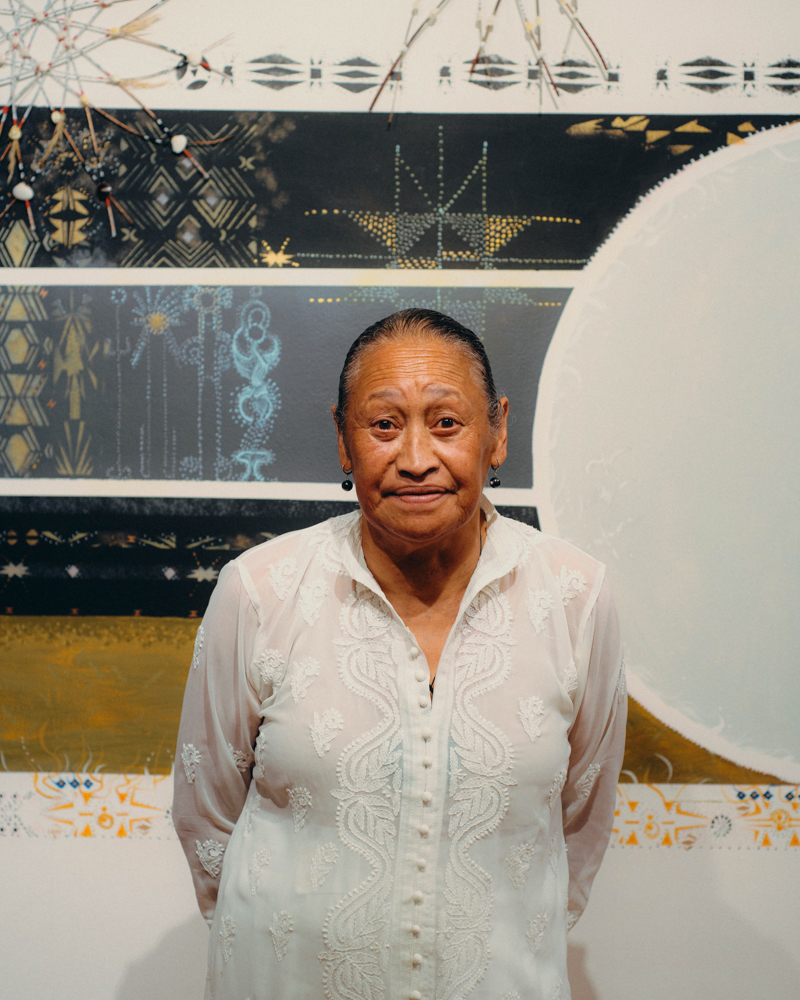
Ruebena is far from slowing down. She relishes sharing her art with others through artist talks and workshops. ‘I love to learn from others and pass on what I do to them.