Age Like a Girl
What if everything you’ve been told about getting older is wrong? Not slightly off or outdated, but fundamentally, completely wrong.
Dr. Mindy Pelz, a two-time New York Times bestselling author, functional health expert and host of the The Resetter Podcast, says it’s time to trust your body.
Words Dr. Mindy Pelz

I’m a post-menopausal woman in my fifties and I want to tell you something I wish someone had told me when I was in my forties. When the hot flashes start, the brain fog rolls in and you barely recognise the woman staring back at you in the mirror: this is not a crisis. This
is a preparation.
Here’s what science actually says.
Your brain does not deteriorate at menopause. It remodels. Neuroscientist, Dr. Lisa Mosconi, one of the world’s leading female brain researchers, has shown that a woman’s brain undergoes profound structural changes three times in her life: at puberty, after childbirth and during perimenopause. Each time, old neurons that no longer serve you get pruned away and new ones emerge. The brain is literally restructuring itself to prepare you for the next chapter.
At puberty, that restructuring wired you for connection and relationship. For nurturing. For care.
At menopause, it’s wiring you for something different.
The brain fog, the irritability, the feeling that you simply cannot keep playing by everyone else’s rules anymore? That’s not you falling apart. That’s the construction happening. The old appliances are being ripped out to make room for the new ones.
When estrogen and progesterone begin their decline, they take with them a cascade of neurochemicals – serotonin, dopamine, GABA and oxytocin. These are the molecules that kept you calm, compliant and focused outward. They helped you absorb other people’s stress without complaint. They helped you say yes when you meant no.
As those chemicals shift, something remarkable happens. Women stop shrinking.
Psychologist, Carol Gilligan, studied this in the 1980s. She found that around puberty, as hormones flooded in, young girls began silencing their own voices to fit the expectations of the people around them. They stopped disrupting. They stopped disagreeing. They learned to please. Most of us have been doing it ever since.
But menopause reverses that.
When the neurochemical armor shifts, the people-pleasing capacity goes with it. For many women, that feels terrifying. Disorienting. But I want you to look at it differently. For the first time in decades, you are hearing your own voice again. Saying no becomes possible. Saying yes to yourself feels necessary.
This is not a loss. This is an initiation.
There is an anthropological concept called the grandmother hypothesis, championed by American anthropologist, Kristin Hawkes. It tells us that in hunter-gatherer societies, the post-reproductive woman was not sidelined. She was essential. Freed from the demands of fertility, her energy redirected into strength, cognition and community leadership. She held the knowledge that kept the clan alive. She was revered.
We are meant to spend roughly 42 percent of our lives in this post-reproductive state. That is not an accident of biology. It is an evolutionary design.
So what do you actually do with all of this?
You work with your biology, not against it. The lifestyle tools that support your brain through this transition are not complicated. They are not expensive. Many of them are the same practices your primal grandmothers used before anyone had a word for menopause.
To support your memory, tell your stories. Write them down, share them with friends. Storytelling stimulates acetylcholine, the neurotransmitter most critical to learning and recall. Move your body every day, especially in nature. Walking and HIIT workouts both boost BDNF, the protein that grows and protects neurons. Keep learning new things. A brain that is being challenged is a brain that stays sharp.
To support your mood, find something that genuinely lights you up and pursue it. Dopamine depends on novelty and purpose, and both are within your control. Get morning sunlight. Research links bright light exposure directly to serotonin production. Spend real time alone. At this stage of life, solitude is not selfish. It is how you find your way back to yourself. And soothe your nervous system daily, whether that is meditation, gentle movement, music or time outdoors.
To support your sleep, try yoga nidra before bed. As progesterone declines, so does GABA, the neurochemical responsible for calming the brain. Slow nasal breathing, herbal teas like chamomile or lemon balm, and creating a genuinely quiet evening routine all help your nervous system shift into rest.
To support your brain fuel, stabilize your blood sugar. This single habit has more impact on brain fog, mood swings and energy crashes than most women realise. Eat omega-3 rich foods. Avoid ultra-processed foods that disrupt the neurochemical balance your brain is already working hard to maintain.
To support your connections, invest in deep relationships. Oxytocin, your bonding neurochemical, declines alongside estrogen. Community is not a luxury at this stage. It is biological medicine. Consider gathering a small group of women and sharing your stories with each other. It sounds almost too simple. The neurochemical payoff is very real.
And through all of it, practice the most important shift of all: stop calling your symptoms a malfunction. Your brain is remodeling. Your body is not failing you. It is preparing you.
There is a woman on the other side of this transition who is clearer, bolder and more herself than she has ever been. The world needs her. Your community needs her.
She is not behind you. She is being built right now, from the inside out.
Trust the process. Trust your body. It has never been broken. It has always known exactly what it’s doing.
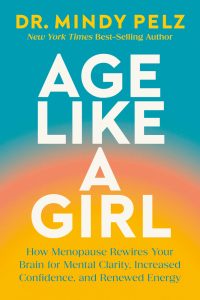
Dr. Mindy Pelz is a 2x New York Times bestselling author and a leading voice in women’s health, hormones and aging. Her books, including Fast Like a Girl and Eat Like a Girl, empower women to work with their biology, not against it. Through her top-ranked podcast, The Resetter Podcast, and YouTube channel with 110M+ views, Dr. Mindy is changing the menopause conversation, helping women unlock energy, brain clarity and purpose in their second half of life. Her latest book, Age Like a Girl, is available now.