A Giant’s Playground
A former economist and politician has spent seven years turning an impoverished golf course and the neighbouring farm into something New Zealand has never quite seen before. Gareth Morgan’s 200-hectare estate is part golf course, part sculpture trail, part conservation project and part underground music club – an eclectic project he says will never be finished.
Words Sarah Perriam-Lampp Photos Nick Tansley
Every weekday, thousands of commuters heading into Wellington on the highway at Transmission Gully glance right and see an oversized feather, the size of a building, balanced on a hilltop or an orange bench seat scaled for a giant. Their local radio traffic report indicates where the traffic flows are identified as ‘the Rainbow Bridge’, a now iconic bridge beside the highway painted in rainbow stripes. A world that has been emerging quietly. One that most commuters are curious to explore more.
Slowly assembled over seven years by a man whose school report once read: ‘No artistic ability whatsoever,’ former well-known economist and erstwhile politician, Gareth Morgan, has been developing The Morgans – 200 hectares of art park, golf course and native bush reserve right on Wellington’s doorstep.
Gareth had been a member at the Pāuatahanui golf course for years with his friend, former radio host Nick Tansley. They loved the small former community golf club precisely because nobody else did. ‘If we got there midweek and there was a car in the carpark, we were quite upset that there was somebody on our course.’
The number cruncher in Gareth wondered how the club washed its face, so he got hold of the accounts, which confirmed the club was slipping away. It duly did, merging with Royal Wellington, who already had two courses and simply wanted the money from selling the course.
With his career in politics establishing The Opportunities Party behind him, and his worldly adventures on motorbikes with wife Jo finished, he was becoming a nuisance. ‘I was annoying Jo a bit, following her around her garden with a wheelbarrow. And she said, go and get your own garden.’ He went and bought the Pāuatahanui golf course.
-
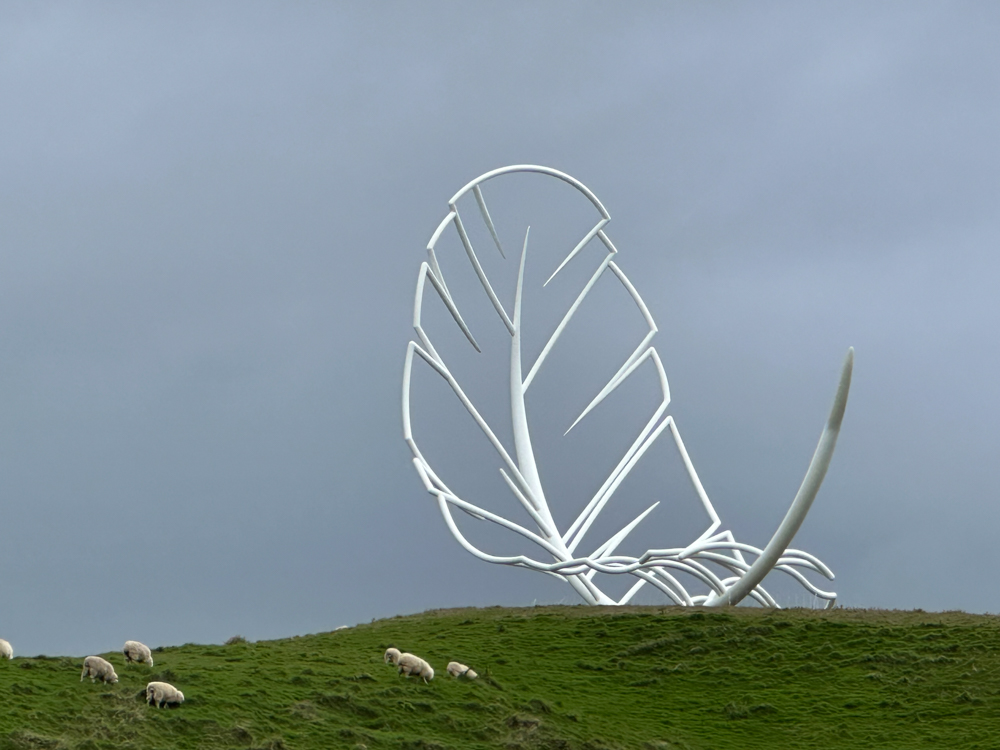
- Touchdown
‘It’s got a few gardeners, you know, so it is a garden.’ Two months later, the farm next door came up, so he bought that too. He then stood on the 200 hectares wondering what on earth to do with it alongside the golf course. The life-long conservationist immediately predator-proofed hectares of regenerating native bush, but there was a yearning for more.
The answer emerged from the family beach house at Mount Maunganui, where two outdoor sculptures produced an unexpected effect. Instead of photographing the beach, tourists photographed their sculptures from the footpath and children shrieked with laughter and joy when admiring them. ‘It dawned on me that if art can hit the right spot, that’s what it does to people. It brings them out of themselves. It’s just pure joy,’ Gareth explains.
A visit to Alan Gibbs’ celebrated sculpture farm in Auckland sealed it. ‘It blew my socks off. It’s probably the best place in the world for outdoor sculpture.’
The giant scale of sculptures that has developed at The Morgan’s was in defiance to a rejection by artist Neil Dawson for a smaller version of the Horizons work he had admired at Gibbs Farm. Instead, Gareth invited Dawson to look at his new Wellington hills instead and commissioned a piece from there.
What Dawson came back with was Touchdown: a feather that appears to have settled on the ridge and looks as though a famous Wellington gust could lift it away again. Beneath it, sits 140 tonnes of concrete and steel, engineered to hold it down. The Art Park has evolved to be an appreciation of the art of engineering, with every piece requiring another layer of wind loading.
The first piece here though, wasn’t a sculpture at all. The famous Rainbow Bridge is 1904 ironwork from the Petone railway workshops, which carried racegoers over the tracks at Trentham for 110 years before it was dismantled and broken. Gareth found it in a yard, bought it and had it rebuilt. He then asked the transport agency if it could be a billboard to advertise the golf course and was told modern expressways don’t have billboards. ‘I thought, well if we paint it bright colours, who needs a billboard? That is the billboard.’
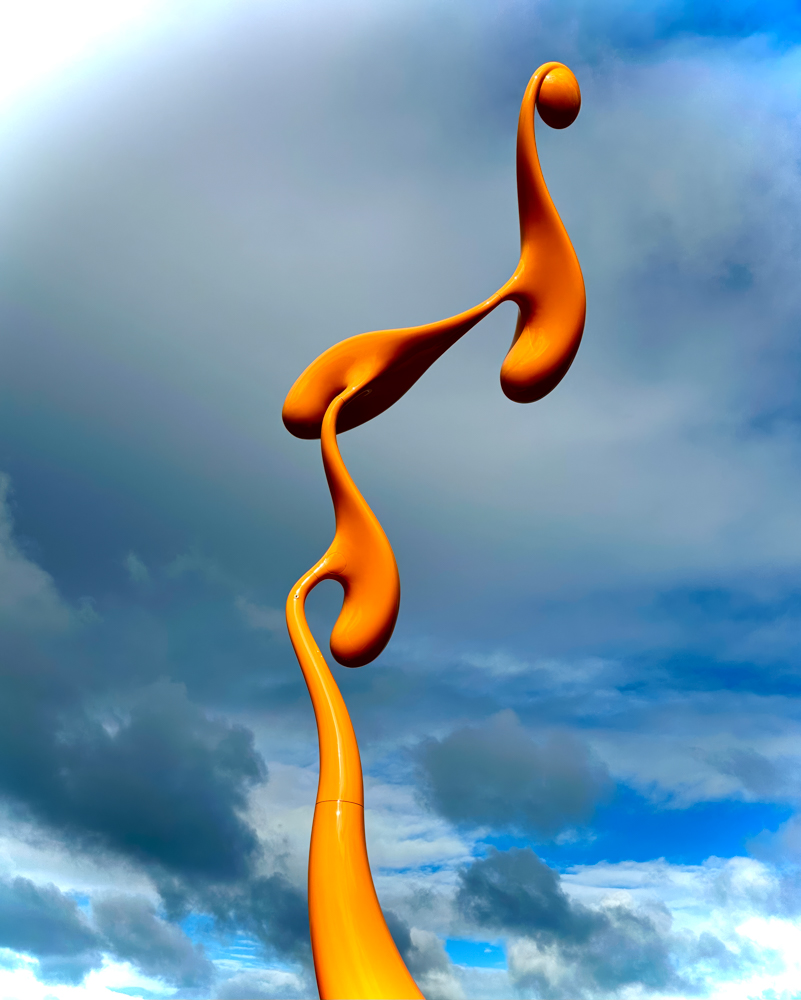
The passionate sculpture enthusiast was deep in his project and moved quickly on to the next installation – Phil Price’s kinetic work Morpheus that dances in
the wind.
-
- Morpheus
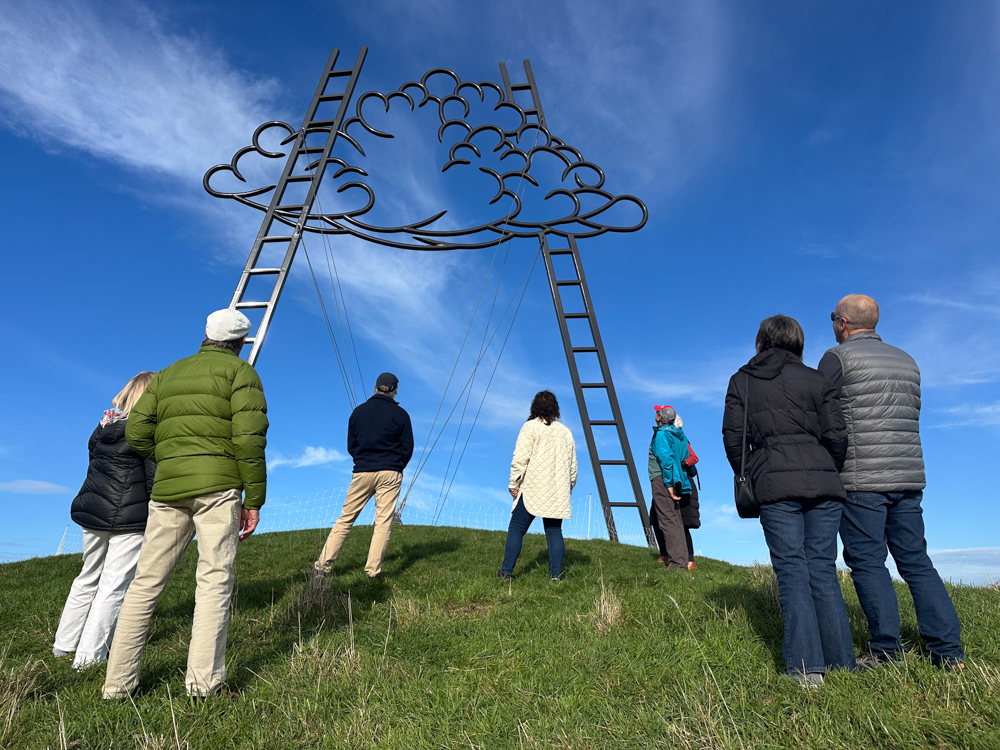
Another ode to the famous Wellington wind by Neil Dawson is Cumulus, a cloud rendered in flat steel, with ladders that appear to climb up into it and vanish. It changes with the weather rather than despite it. On a clear day, it reads as a drawing hung in mid-air. On a windy day, when real clouds come racing over the ridge behind it, the flat form suddenly acquires depth and the whole thing seems to be moving. ‘It comes into its own when there’s clouds competing with it,’ says Gareth, ‘and those ladders disappear up into the clouds. It’s just nuts.’
The undulating 4.5km Art Park trail was built originally for walkers and cyclists before he had second thoughts. ‘What are we going to do with the other 90 per cent of people who want to see these sculptures?’ Sculpture audiences, he points out, skew older. The answer was a fleet of comfortable open cruisers with guided tours run by the energetic team of Nick Tansley and Camilla Welch. For decades, Nick anchored a popular morning radio show alongside Polly Gillespie and Grant Kereama; and now thoroughly enjoys his next chapter of talking to and entertaining The Morgan’s Art Park visitors. ‘We’ve had families here with granddad and grandma in their 90s, and the kids as young as eight years old, and they all get an exhilarating experience,’ says Nick.
-
- Cumulus
The tour begins with a work that stops people immediately in their tracks. Star-Crossed Lovers, by Georgian artist Tamara Kvesitadze, is a pair of towering figures rotating in slow, deliberate opposition. For most of their four-and-a-half-minute cycle they stand back to back like strangers. Then they turn, appear to embrace – and pass straight through one another before resuming their separate orbits.
Gareth saw the original at twice the scale on a Black Sea beach, tracked down the artist and had a smaller version built in Germany and assembled here. It has stood through 180 km/h winds without missing a beat.
The love story behind it crosses a religious and cultural divide. A story of forbidden love between two families that ends badly. ‘It’s actually like many normal New Zealand relationships, where you only see each other for a couple of seconds and then you carry on and do your careers,’ laughs Nick.
Further along, four familiar figures stand together after their passing. It is a tribute to the infamous men of Wellington’s streets – Blanket Man, the Juggler, Bucket Man and Kenny, who sang ‘The Gambler’ for years. Another ode to the capital city that Gareth has lived in since the 1970s.
-
- Dining with the Birds.
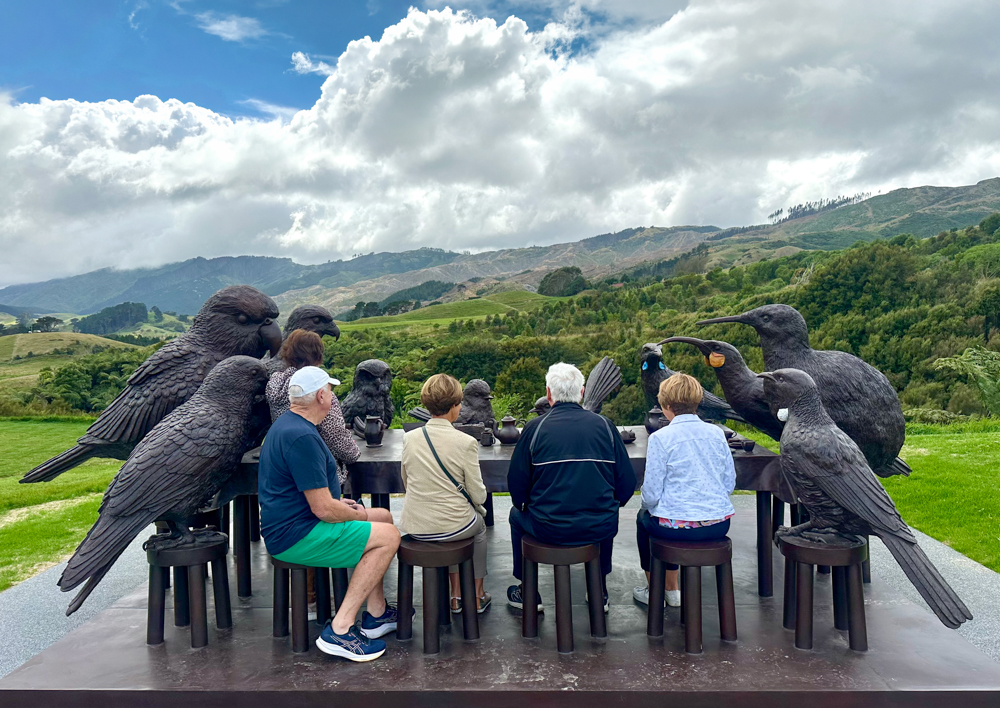
If Star-Crossed Lovers is the piece that makes people go quiet, Dining with the Birds is the one that makes them stay – a bronze tea party by Australian artists Gillie and Marc, where the guests are iconic New Zealand native birds and a few chairs are left empty for visitors. Gareth first saw a piece of their work in London that had elephants and giraffes in a Mad Hatter’s tea party type setting. ‘People stroke the bronze feathers and they sit and have their cup of tea and look at the irony of the endangered birds beside the regenerating New Zealand native bush. It really moves people,’ shares Camilla. They have many other pieces by the same artists around the park such as a crocodile, a baby snail and a dog and a rabbit riding a tandem bike.
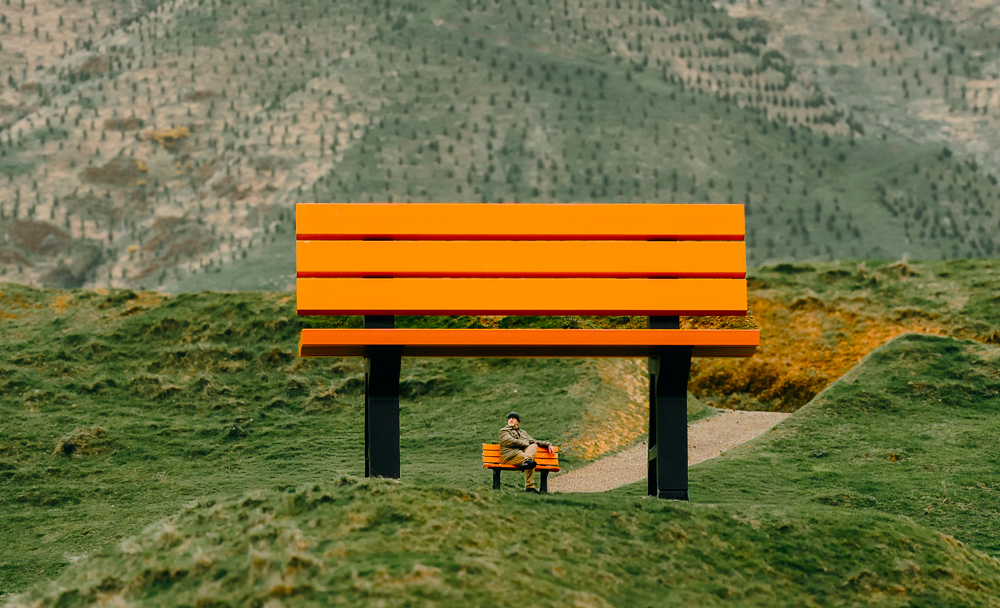
Then there is the famous giant orange bench seat. The inspiration came from the golf course which is dotted with small recycled-plastic seats. Why not create an over-sized bright orange bench, parked on the hillside above the traffic, waiting for an occupant who is never going to arrive? ‘If there was a big giant sitting there watching the comings and goings of Transmission gully, it would be the perfect spot,’ says Nick. He says it’s the most straightforwardly silly thing on the property and quite possibly the most photographed.
The golf, meanwhile, has had stripped from it everything that makes conventional golf clubs: no members, no committee, extended times between tee-offs. Guests to Pāuatahanui book online, collect a one-day pin code for the gate, play their round and leave. ‘People come here and actually like the fact they seldom have their game interrupted by others,’ says Nick.
Nick and Gareth’s love of music has seen the old clubhouse – two army sheds pushed together, barely touched since the 1960s – become their underground music hall. A newsletter to subscribers invites followers to sit at cabaret tables every six weeks and listen to bands such as The Phoenix Foundation, Barnaby Weir, Louis Baker and members of Fat Freddy’s Drop. Supper is sausages on white bread, the capacity is 80-odd people. ‘The well- known New Zealand artists get quite nervous because the audience is small and right there,’ says Gareth.
Gareth could be anywhere, but four children, 10 grandchildren and half a century in Wellington say otherwise. ‘What am I going to do – buy a super yacht and cruise the Med? Go and live in Monaco? This is home.’
-
- Bench Seat for a Giant.
Plan your visit to The Morgans
Location: 30 minutes from Wellington city,
Sculpture tours run on open cruisers along the 4.5 km trail; walking and cycling are also available. Suitable for limited mobility.
Golf: book online, no membership required; a one-day pin code is issued for the gate.
Clubhouse concerts: roughly every six weeks, around 80 seats. Subscribe to the mailing list for ticket releases.
Dining with the Birds: bronze tea party, with seats for visitors. Bring the grandchildren.
Plan your visit at themorgans.co.nz